
For years, Britain called to me. I had visited London a couple of times, but this was different. This was the journey I had dreamed of: driving through England, Scotland and Wales, green hillsides and country lanes, walking on cobblestones, breathing in a place that felt – dare I say it – like home. One of my longest-held dreams was to visit the grave of our family ancestor, James Tomlinson, in Keswick, Cumbria. And so I finally did on a very cold, rainy and windy day, everything exactly as I had always imagined it.
Fortunately I loved the rainy weather. Dressed warm, layered up, my heart and soul absorbing every grey sky and drizzly morning. The countryside was breathtaking – mist over green valleys, the magnificent highland mountains and moors, hedgerows alive with new growth, stone walls and castles standing proud as they have for centuries.
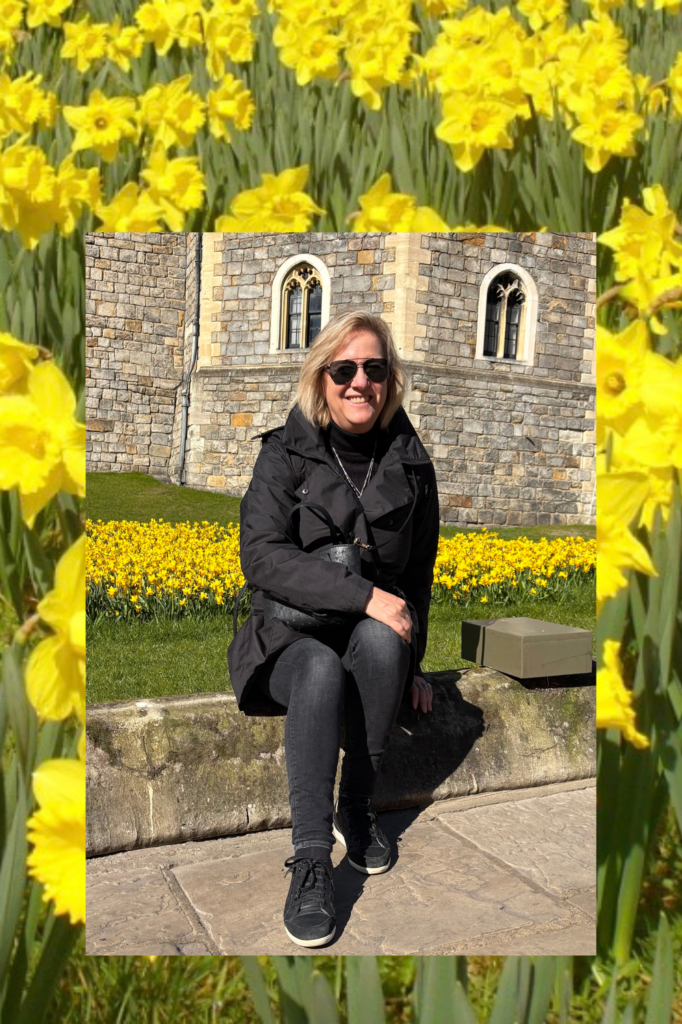
And then – The Daffodils.
Oh how he knew:
“I wandered lonely as a cloud, That floats on high o’er vales and hills,
When all at once I saw a crowd, A host, of golden daffodils; Beside the lake, beneath the trees,
Fluttering and dancing in the breeze.”
Britain in spring doesn’t just quote the poem. It is the poem.
At four degrees, the only thing that got cold was my teeth – from smiling so much.
But what I never expected – what truly stole the show – was the people.
Just as the golden daffodils push their bright heads through cold, wet earth, simply warm, simply radiant – so too are the British people. Warm, hospitable, and genuinely polite.
- The barman in York
After a day’s walking, my husband an I went to a pub to have something to eat and drink. Being a vegetarian with an allergy to corn, makes it very difficult to find street food, so I was famished. We struggled using the pub app to order food, and our banking app kept on declining the order. The barman simply leaned in and offered to pay for us. We first declined, but he insisted, calling it: “British hospitality”, we paid him in cash afterwards, stating “South African gratitude”.
- Shops, hotels, and restaurants
Everywhere we went – from a tearoom, a hotel, a shop or a restaurant – staff were chatty, warm and genuinely interested. It was the kind of attention that makes you feel seen and valued.
- Stranger to Stranger
People holding doors for one another, exchanging pleasantries with staff, a “good morning” and a “thank you”, a social contract that was alive and active. Politeness was not reserved for family and friends, it was simply how people moved through the world.
- The road and the wave
On the motorways we soon realised that it is proper to keep left, the middle lane was for faster traffic, and the right lane mostly open for overtaking. In general drivers kept to the speed limit and following distance, a quiet choreography of mutual respect. But it was the country roads that charmed me most. On single-track roads, one car would pull off into a “passing place” to allow another car to pass. Every single time, we would get a wave of acknowledgment from the other driver.
The psychology of considerate people
What struck me most is that British politeness is not merely etiquette, but empathy made habitual. Psychologists call it prosocial behaviour: the deep-seated tendency to consider how one’s actions affect others, and to adjust accordingly. It is consideration not as performance, but as reflex.

I loved every aspect of my travels through Britain – the scenery and the people, and I think part of me stayed behind in the Highlands. However until I can return, I have a memory etched into my soul:
“I gazed—and gazed—but little thought
What wealth the show to me had brought:
For oft, when on my couch I lie
In vacant or in pensive mood,
They flash upon that inward eye
Which is the bliss of solitude;
And then my heart with pleasure fills,
And dances with the daffodils.”